


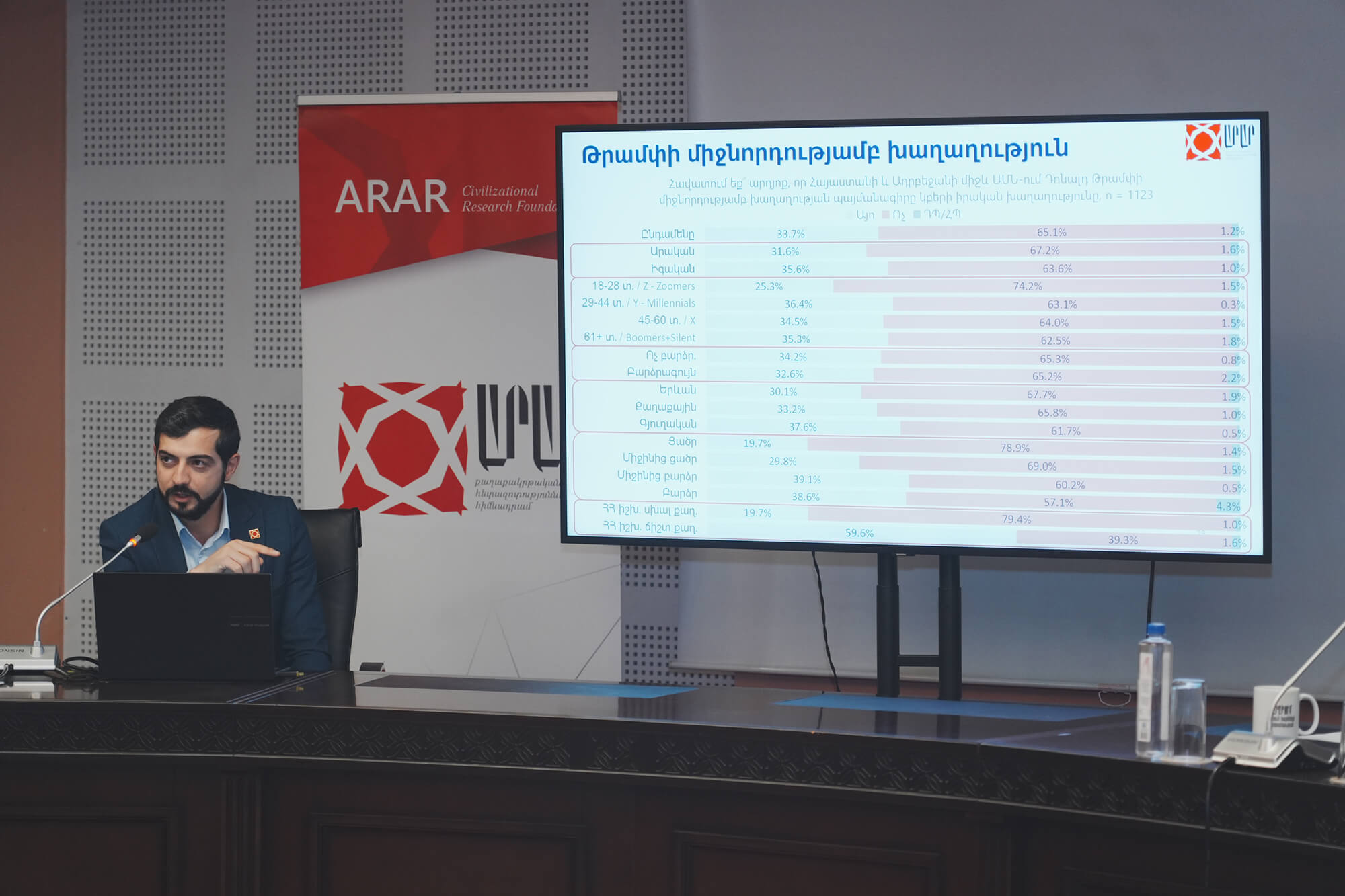
On November 11, Armen Khachikyan, Director of the ARAR Civilizational Research Foundation, presented the results of a sociological survey exploring current public and political attitudes in Armenia.
“ARAR Foundation regularly conducts nationwide quantitative surveys every quarter to better understand public sentiment on major issues,” Khachikyan said in his opening remarks. “This time, we focused on topics that have sparked active debate in recent months — Azerbaijan’s intentions toward Armenia, Donald Trump’s proposed peace initiative, the need for constitutional reform, and other related issues.”
The survey was conducted from October 5 to 25, with 1,123 respondents participating.
Public Satisfaction with Institutions
According to the results, the Armed Forces (66.4%) and the Armenian Apostolic Church (62.5%) remain the most trusted institutions in the country. Satisfaction with the Police stands at 54.6%, while public dissatisfaction is highest toward the Government (39.5%) and the National Assembly (50%).
Younger respondents — particularly Generation Z — expressed the strongest trust in both the Church (82.5%) and the Armed Forces (around 70%).
Meanwhile, people aged 45–60 and those with lower socioeconomic status were the most dissatisfied with the National Assembly (62.7%).
Political Attitudes
According to the survey, 51.8% of respondents believe that the Armenian authorities are pursuing a wrong foreign policy, and 62.7% think the same about the domestic policy. Dissatisfaction is especially high among people with low socioeconomic status — 68.3% are unhappy with foreign policy and 75.4% with domestic policy — showing that the lower the living standard, the stronger the discontent.
One of the survey questions focused on the possibility of achieving peace with Azerbaijan. A large majority — 69.2% — believe that long-term peace cannot be achieved through negotiations, while 30.5% think it is possible. Notably, more than 70% of respondents aged 18–44 do not believe in lasting peace with Azerbaijan.
Participants were also asked about the prospect of peace mediated by Donald Trump. According to the results, 65.1% of respondents believe that a peace agreement mediated by Trump between Armenia and Azerbaijan would not lead to real peace, while 33.7% think such an outcome is possible.
Regarding internal reforms, only 35.1% of respondents consider the adoption of a new Constitution necessary. At the same time, 49% said they would respond positively to a call for unity issued by the Armenian Apostolic Church, despite the recent criticism directed at it.
When asked about possible reductions in the defense budget or army personnel following a peace deal, 80.2% opposed such measures, while 19.1% supported them.
On the issue of the Russian 102nd military base, 64% of respondents are against its withdrawal from Armenia, and 32.1% support it.
The survey also revisited the topic of the return of former authorities: 78.6% of respondents are opposed, while 18.3% support their return.
An overwhelming 91.3% rejected the idea of amending Armenia’s Constitution at Azerbaijan’s request in exchange for peace.
Finally, respondents were asked what they believe to be Azerbaijan’s long-term goal toward Armenia.
48.5% think it is the complete destruction of Armenia,
17.4% — the establishment of peaceful relations and economic cooperation,
15.0% — the weakening of Armenia’s independence and creating dependency,
13.7% — the seizure of part of Armenia’s territory.
Foreign Relations
This survey also included a question regarding Armenia’s defense alliance partnerships. According to the results, 37.8% of respondents believe that Armenia should establish a military alliance with Russia, 18.3% favor one with the United States, 17.5% with Iran, 15.9% with European Union countries, and 5.4% with India. Support for a military alliance with Russia is particularly strong among rural residents (42.8%) and among those with lower levels of social welfare (54.2%).
The presentation of the sociological study brought together experts from various fields, who actively discussed the findings and also proposed new directions for future research.
The full survey results can be downloaded here.