


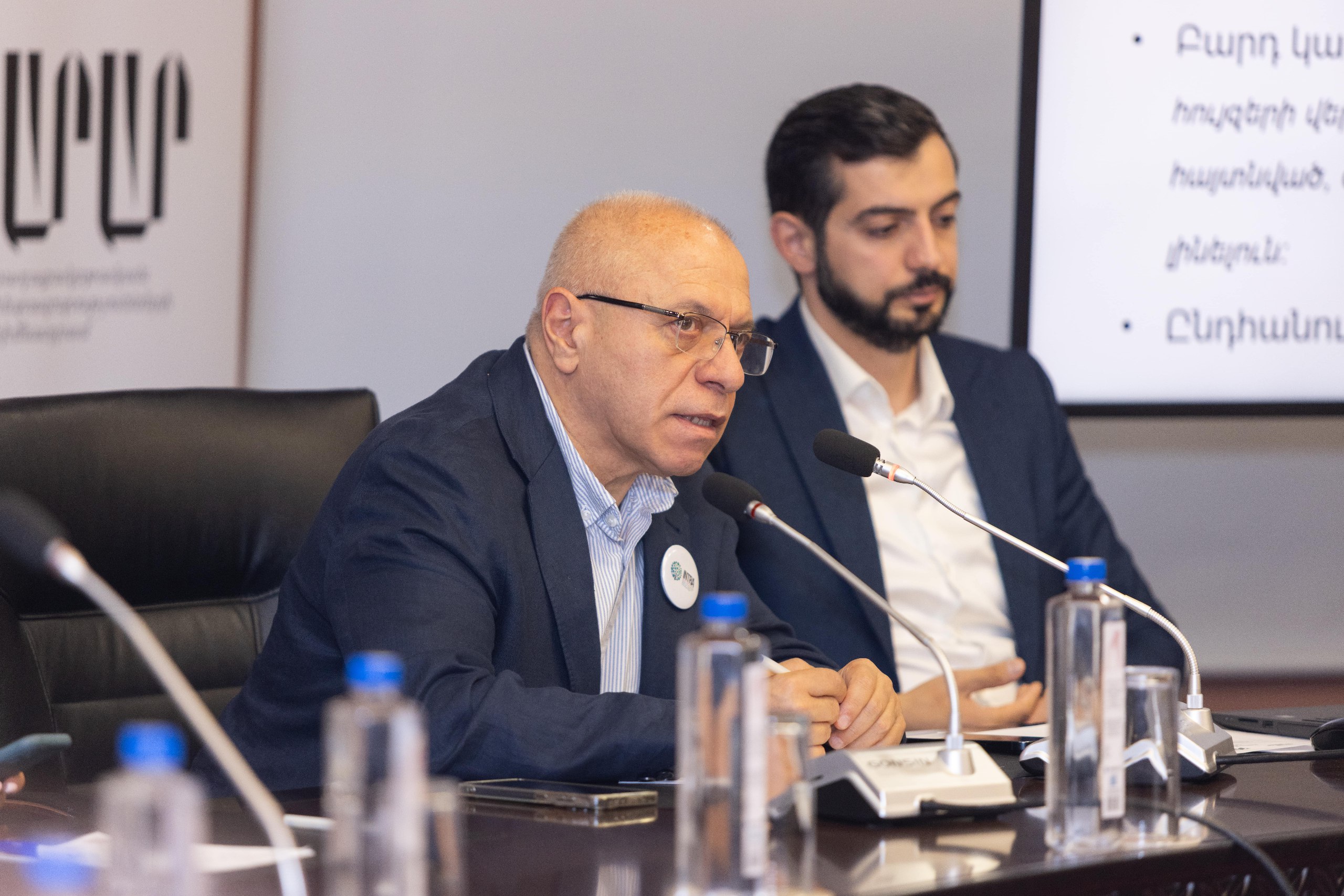
Today, on World Mental Health Day, the findings of the research titled “Psychological Consequences of War and Solutions for Recovery” were presented through the joint efforts of the ARAR Foundation, the Armenian Spiritual Revival Foundation, and the Intra Mental Health Center.
Before presenting the findings, Khachatur Gasparyan, Director of the Intra Mental Health Center and psychologist-expert, spoke about the importance of World Mental Health Day, stressing that mental health is just as vital as physical health. He also underlined the need to prevent the transmission of trauma from older to younger generations.
Afterward, Armen Khachikyan, Executive Director of the ARAR Foundation, presented the research findings, emphasizing the connection between mental health and national security.
“We analyzed the data to reveal the levels of depression, anxiety, and PTSD among respondents,” noted Armen Khachikyan.
According to the research, about 46% of respondents have an above-average level of depression. Among unemployed respondents, severe cases of depression is 26%, which is twice as high as among employed respondents (12%). Severe cases of depression are lowest among married respondents, at 13%. Social isolation leads to severe mental health conditions.
Severe cases of PTSD affect more than half of the participants (50.5%).
Medium cases are also significant, at 35.2%, while only 14.3% fall into the low category. Among employed individuals, mild cases of PTSD are the most common, at 18.3%, while severe cases are relatively low at 35.4%, suggesting a possible positive effect of employment. Unemployed individuals and students show very high rates of moderate PTSD, ranging from 53–56%. Among retirees, the highest proportion of severe PTSD cases has been observed, at 48.4%, which may be related to social isolation, age-related challenges, or accumulated past traumas. Among widowed individuals, severe PTSD is highest (57.3%), while low PTSD cases are the lowest (6.5%), suggesting a significant psychological impact from loss and social isolation. 28% of respondents have severe anxiety.
Hovhannes Nikogosyan, Director of the Armenian Spiritual Revival Foundation, and Ani Manukyan, Head of Spiritual-Psychological Programs, spoke about the foundation’s activities and ongoing programs.
To help individuals cope with the psychological impact of war and crisis, the Armenian Spiritual Revival Foundation – established through the initiative of Armenian-American philanthropist and entrepreneur Nubar Afeyan – implements comprehensive spiritual and psychological support programs.
“Our work begins when people already have their most basic needs met. That’s when a new question arises: how to live again—how to regain faith, strength, and meaning. Through a spiritual-psychological approach, we address the personal dimensions of collective trauma, helping individuals restore functionality, find inner balance and faith, and rebuild a sense of purpose and hope for the future,” explained Hovhannes Nikogosyan during the press briefing.
Ani Manukyan presented the foundation’s flagship program, “The Armenian Path to Recovery,” which brings together psychology, historical memory, spiritual values, and identity awareness. She noted that, based on the foundation’s experience, group formats have proven to be the most effective, as they broaden access to psychological support, strengthen community ties, and help individuals cope with severe psychological challenges.
“We have developed a specialized training program for psychologists and social workers that offers in-depth instruction, supervision, and practical guidance. Trained professionals will deliver group support sessions across different regions of Armenia, using the foundation’s spiritual-psychological methodology,” Ani Manukyan added.
To date, the foundation has trained dozens of specialists, who have already supported more than 4,000 adults and adolescents. Looking ahead, the organization plans to expand collaboration with government institutions to scale the initiative and make spiritual-psychological support accessible to a wider population. In the long term, the foundation aims to position Armenia as a hub of spiritual-psychological innovation, turning national experience into an international model.
At the close of the event, Khachatur Gasparyan, Director of the Intra Mental Health Center, introduced the newly relaunched sgmf.am website of the Seda Ghazaryan Mental Health Foundation. He emphasized that the center has worked with diverse social groups for many years, and that bringing this information together online makes it more accessible to the public.
The professional discussion brought together psychologists, experts in the field, and media representatives.
You can download the research findings here.